I'm Looking for...
This post contains links through which we may earn a small commission should you make a purchase from a brand. This in no way affects our ability to objectively critique the products and brands we review.
Evidence Based Research To fulfill our commitment to bringing our audience accurate and insightful content, our expert writers and medical reviewers rely on carefully curated research.
Read Our Editorial Policy
If you’re looking for a potent anti-inflammatory, antioxidant, and/or weight loss tool that comes from the Earth, then yes, turmeric is worth the hype.
Turmeric inhabits an interesting place (or rather, several places) in the ever-evolving health supplement industry.
On the one hand, this increasingly popular spice has been a trusted staple of a millennia-old healing tradition, but at the same time, it’s being evaluated right now by the modern research establishment for its possible therapeutic potential.
As it turns out, both traditionalists and scrutinizing scientists agree on some of turmeric’s benefits, like its apparent ability to help with muscle soreness and inflammation, but other claims surrounding this ancient herb remain in contention between these two camps.
All the while, turmeric continues to fly off the shelves, which begs the question, do we really know what we’re taking?
As always, the best way to cut through the haze of misinformation and hype surrounding popular supplements like turmeric is to follow the evidence.
Then, you’ll be empowered to make an informed purchase when you’re ready to harness the healing powers of a turmeric supplement.
Turmeric is a plant native to southeast Asia; it has a finger-like root structure strongly resembling ginger, and in fact, turmeric and ginger are part of the same family (Zingiberaceae).
Used most commonly as a spice, turmeric is often described as having a bittersweet taste, emphasis on bitter.
Indians have been using turmeric as part of their traditional healthcare system, Ayurvedic medicine, for as long as four millennia.
Indeed, the active compound in turmeric, a substance called curcumin, has been correlated with improvements in inflammation, soreness, and other issues.
Here’s a brief glimpse at the state of the research surrounding curcumin’s many purported uses.
Turmeric actively scours the body for “reactive oxygen species,” which is another term for harmful free radicals.
This 30-participant study conducted by pharmacology experts at the University of Alicante in Spain found that use of curcumin for 60 days lowered levels of peroxidized lipids—a type of harmful free radical—to a clinically significant extent.
This is the mechanism of action associated with that word so frequently echoed, but so rarely explained by health product manufacturers: antioxidant.
As an antioxidant, turmeric carries the potential to defend against a harmful overabundance of free radicals (a certain level of free radicals is actually necessary) by stabilizing these unstable molecules with a donated electron.
A 25-participant human trial by the University of California at San Francisco found that 1125-2500mg of curcumin per day inhibited more than a dozen pro-inflammatory substances found in the human body, including prostaglandins, tumor necrosis factor (TNF), and more.
Notably, studies using even slightly lower doses of curcumin have not been nearly as convincing in their demonstration of anti-inflammatory action, which is an indicator of turmeric’s poor bioavailability.
This means that the active ingredient in turmeric is absorbed by the body very inefficiently, but as we’ll discuss below, bioavailability can be increased safely using certain methods (so that massive doses aren’t needed).
Interestingly, some studies are strongly suggesting that curcumin can attack even medication-resistant strains of bacteria.
This study from Wonkwang University in Iksan, South Korea shows curcumin’s mettle as an anti-MRSA (methicillin-resistant Staphylococcus aureus) agent, outperforming ethyl acetate and methanol in a simulated “bacterial invasion.”
To be clear, no curcumin extract has been approved by the FDA to treat this potentially serious infection, but they have assigned curcumin GRAS (generally recognized as safe) status.
Weight gain and metabolic dysfunction are more nuanced than people make them out to be; maintaining a healthy weight is not always as simple as balancing caloric intake and output.
While that ratio is extremely important to maintaining a healthy weight and metabolism, genetic and environmental factors outside of diet and exercise can promote the downward spiral of inflammation, high blood pressure, heart problems, and other issues associated with weight gain.
This is why the seemingly unrelated anti-inflammatory potential of curcumin is being considered as a key component to treating metabolic disorders, per this study by the Baqiyatallah University of Medical Sciences in Tehran, Iran.
In this 117-participant study, curcumin was found to reduce concentrations of pro-inflammatory substances in the blood of metabolic syndrome sufferers as compared to placebo.
Finally, curcumin may be able to improve tissue healing, as evidenced by this 32-participant study by Recep Tayyip Erdogan University in Turkey.
Participants in the “high-curcumin” group (as opposed to low-curcumin, placebo, and alternative treatment groups) showed improvements across all major stages of wound healing, including inflammation reduction, tissue remodeling, and more.
In addition to confirming the link between curcumin and skin healing, this observation also adds credence to the bioavailability issue, since the low-curcumin group did not demonstrate equally impressive outcomes.
As mentioned, the FDA has officially assigned turmeric GRAS status, meaning that even in high doses, turmeric is not likely to reap any seriously harmful effects.
However, some milder side effects have been reported by researchers, including the following:
It’s also important to consider the manner in which you’re taking curcumin, i.e., what you’re taking it with, because poorly formulated supplements can introduce a toxic element to this otherwise non-toxic substance.
While you can cook with turmeric, the best way to reach a therapeutically effective turmeric intake is with a supplement.
Ask a Thai or Indian cuisine purist, and they’ll scoff at the idea of a homemade curry or a side of yellow potatoes with the turmeric left out.
Indeed, the intensity and flavor profile of this spice render it an excellent addition to many dishes native to these culinary traditions and others, but we have two problems.
First, as well-liked as they are, traditional Indian dishes aren’t exactly easy to make for busy people who didn’t grow up doing so.
Second, the amount of turmeric you would have to add to reach the same therapeutic targets that some of the above studies did would certainly ruin your curry, potatoes, salad, or vegetables.
Enter the turmeric supplement.
Turmeric has already withstood objective scrutiny to the point of FDA acceptance, if not approval; we already know that it works and that it’s safe.
This is why we evaluate supplements based on how effectively they remove roadblocks (i.e., low bioavailability in this case) between this already beneficial ingredient and you, not by how many gimmicky supporting ingredients they add.
In that spirit, we wholeheartedly recommend simple, soundly formulated supplements that seek to boost bioavailability.
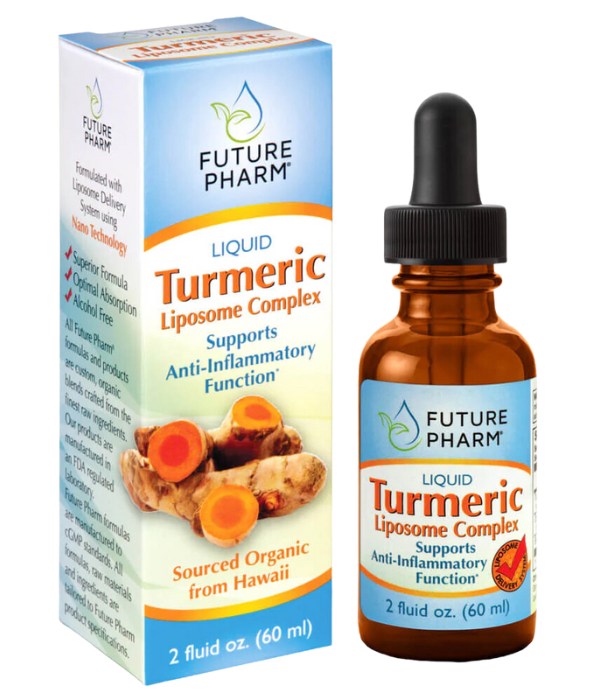
Organically sourced turmeric supplement that attacks inflammation.
Liposomal Proprietary Blend: Organic Turmeric Root Powder (5% Curcumin), Turmeric Root Extract (95% Curcumin), BioPerine (Black Pepper Extract), Organic Glycerin USP (Kosher), Purified Water USP, Lecithin, Liposome Complex, Xanthan Gum.
Future Pharm’s Turmeric Liposome Complex is an all-natural turmeric extract derived straight from the plant, and it’s engineered to significantly increase bioavailability using safe, non-toxic liposomes.
Liposomes are cell-like structures that can absorb, carry, and deliver many kinds of substances to our existing cells, greatly increasing the uptake of a poorly absorbable substance without massive doses.
There’s no need to pop the lid off of that turmeric jar and suffer through a deluge of bitter heat when there are supplements as effective and safe as this Turmeric Liposome Complex.
It’s not to say that incorporating turmeric into your diet won’t help at all – and who doesn’t love Indian food – but with smart supplementation behind you, it’s much easier to safely work your way into a more effective dosage range.
Check out our list of the six best natural toners, including options for sensitive and acne-prone skin, those on a budget, and even anti-aging toners.
Read More