I'm Looking for...
This post contains links through which we may earn a small commission should you make a purchase from a brand. This in no way affects our ability to objectively critique the products and brands we review.
Evidence Based Research To fulfill our commitment to bringing our audience accurate and insightful content, our expert writers and medical reviewers rely on carefully curated research.
Read Our Editorial Policy
Summer’s here, and that means one thing is more important than ever: sunscreen to protect your beautiful skin from the harmful effects of excessive sun exposure.
As summer brings higher UV intensity—meaning, the sun’s harmful UV rays are more intense and likelier to cause sunburns or skin cancer—it’s extra essential to dial in your sunscreen routine.
It sounds easy enough—just slather it on and call it a day, right? Well, not so fast. Keep reading to learn all the best practices for applying sunscreen, including when to use it (before or after makeup and moisturizer?) and how often to reapply it.
While we want to produce vitamin D in our skin from the sun, the high UV index of summer days can quickly turn healthy vitamin D production into an unhealthy sunburn that increases your risk of skin cancer.
As a quick aside, for an in-depth look at how long you should get unprotected sun exposure to produce vitamin D without burning, check out this article: How Much Vitamin D Do You Get From the Sun?
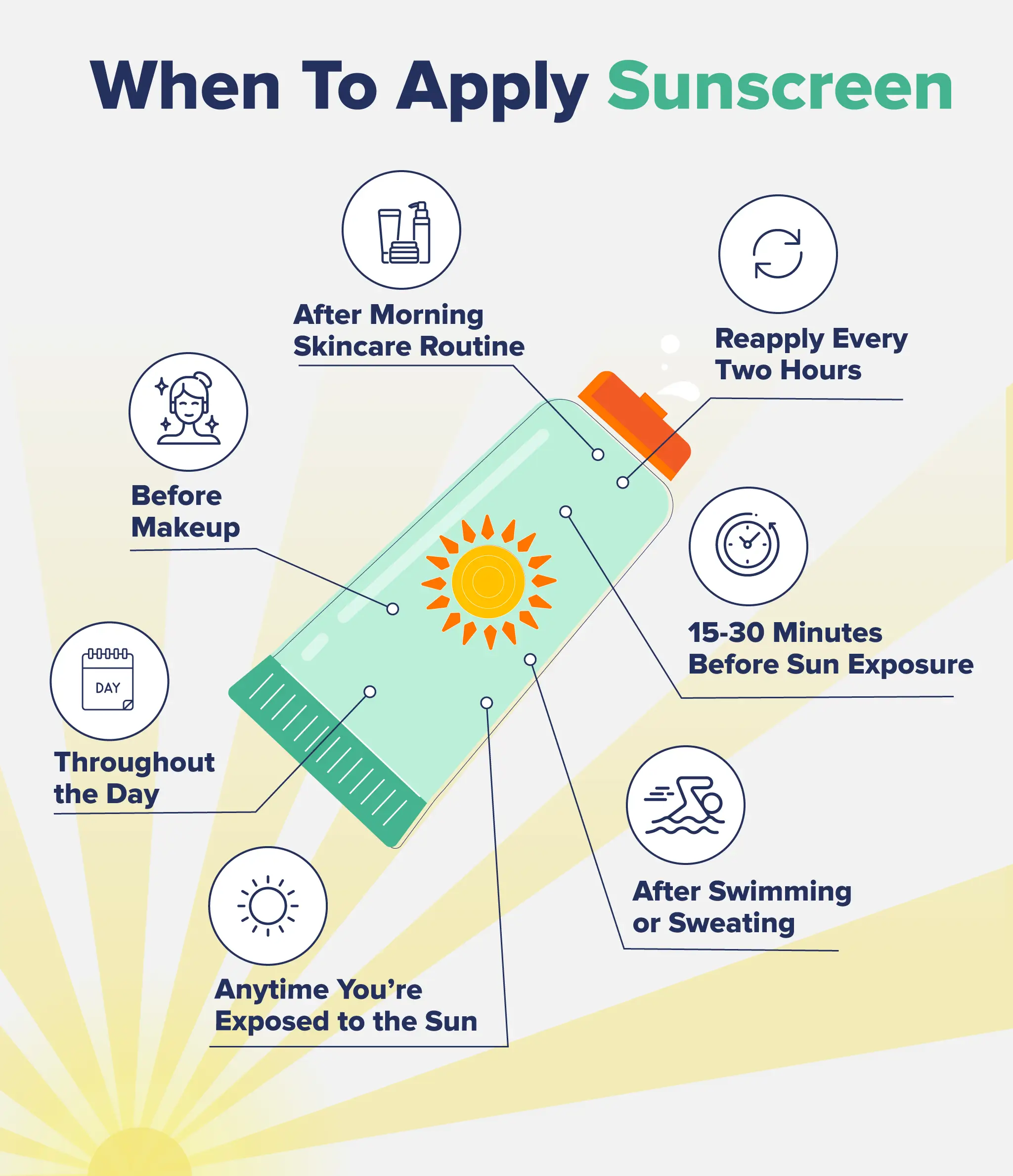
So, when exactly should you apply sunscreen within your daily skincare or makeup routine?
Dermatologists and skincare experts don’t have a hard-and-fast rule about when to apply sunscreen.
It’s generally recommended to apply face sunscreen after the last step in your morning skincare routine. This could look like:
If your morning skincare routine has more steps, you should still apply sunscreen as the last step—but before applying makeup.
Many makeup products, like foundation, have SPF (sun protection factor) in them, but you should not rely solely on that for sun protection. It’s often in lower amounts, and you may not get full coverage from it.
Other experts, like those at Johns Hopkins School of Medicine, say that it doesn’t really matter when sunscreen is included in this routine.
They state, “So long as the sunscreen is at least SPF 30, water-resistant and broad-spectrum, it doesn’t matter in what order you apply your skin care products. Some people find it’s easiest to work with bare skin—before makeup or moisturizer have been added.”
The American Academy of Dermatology (AAD) recommends wearing sunscreen with an SPF of 30 or higher on your face, lips, and body and reapplying sunscreen every two hours. As most people won’t want to put sunscreen on their lips (yuck), look for a lip balm with SPF.
You should aim to use at least one ounce of sunscreen––the equivalent of a shot glass––on your body every two hours that you’re in the sun.
Your face (and don’t forget your ears!) needs less, averaging about ½ of a teaspoon per application.
If you are swimming, sweating, or in very humid weather, you will likely need to reapply sunscreen sooner than two hours. In some cases, you may need to reapply in as little as 30 to 40 minutes.
If you are wearing makeup and need to reapply sunscreen on your face, try a brush-on powdered sunscreen like this one from Clearstem Skincare.
Keep in mind that sun safety is not all about preventing sunburns and skin cancer—these tips can also reduce sun damage to your skin and premature aging.
You should also seek shade during peak hours and avoiding direct sunlight when possible and wear wide-brimmed hats to help keep the sun off your face. Also consider wearing UPF (Ultraviolet Protection Factor) clothing to block out UVA and UVB rays further.
It’s better to apply sunscreen after moisturizer and other skincare products. Allow your moisturizer to soak into your skin first (it shouldn’t feel wet, tacky, sticky, etc.) before applying sunscreen. Then, apply makeup (if you are using it) after your sunscreen.
You should wait until your moisturizer has thoroughly soaked into your skin and been absorbed. This means that you shouldn’t be able to feel it on your skin anymore—it shouldn’t feel tacky, wet, sticky, or anything like that. Depending on the moisturizer, this could take anywhere from 2 to 20 minutes.
While it can count, it should not be your only source of face sunscreen. Many makeup products, like foundation, have SPF in them, but you should not rely solely on that for sun protection. It’s often in lower amounts, and you may not get full coverage from it.
It’s best to apply your moisturizer and sunscreen separately, as you want the ingredients in both to be able to fully do their job. Mixing them together will reduce the effectiveness of the SPF—and probably of the moisturizer’s ingredients, too. Apply moisturizer first, wait until it fully soaks in and dries, then add your facial sunscreen.
Also known as mineral sunscreen, physical sunscreens provide broad-spectrum protection (meaning they protect against both spectrums of UV radiation, UVA and UVB) by reflecting UV rays away from your skin. Zinc oxide and titanium dioxide are the two ingredients most commonly found in mineral sunscreens and are primarily recommended for non-toxic sunscreen options. Chemical sunscreens use chemicals that absorb UVA and UVB rays before your skin can absorb them. These active compounds include oxybenzone, octinoxate, avobenzone, and more. Several of these chemicals are considered endocrine disruptors that interfere with healthy hormone activity. Oxybenzone is also banned in several countries because it harms marine ecosystems and coral reefs. If you have the option, we’d recommend physical sunscreen over chemical sunscreens.
Yes, as long as your tinted sunscreen has a high enough SPF (ideally SPF 30 or more), there’s no reason why it won’t be as effective as regular sunscreen. Tinted sunscreens may even be more effective because they include iron oxides, such as zinc oxide and titanium dioxide, that block UVA and UVB rays.

There’s something disarming about seeing the word “corn,” “safflower,” or “vegetable” sandwiched between fifteen-letter-long preservatives on food labels, which is one reason why unhealthy vegetable oils have evaded serious criticism for so long.
Read More